The Best Time to Visit Chihuly Garden and Glass
Day or night, weekday or weekend, summer or shoulder season — how the light and the crowds actually change at Seattle's glass museum, and when to arrive.
Most attractions have a best time in the sense of a least-bad time — the hour when the queue is shortest. Chihuly Garden and Glass is different, because the exhibition genuinely changes. Half of it sits under a glass roof and half of it sits outdoors, so the sun is part of the artwork. Get the timing right and you see two versions of the same site on one ticket; get it wrong and you see one.
Check Availability
Daylight and after dark are two different visits
In daylight, the Garden works as a garden. Glass is planted among live rhododendrons and evergreens rather than displayed against them, and sunlight coming through the pieces from behind is what makes the colour do anything. The Glasshouse, roofed in glass, is lit entirely by the sky — on a bright afternoon the suspended sculpture reads as translucent, almost weightless.
After dark, both flip. The Garden is floodlit and the glass becomes the only lit thing in a black frame, which is a far more theatrical and much more photographed effect. The Glasshouse turns from a translucent ceiling into a glowing one against a dark sky. The eight interior galleries, which are kept close to black at all hours, are the one part of the site that does not care what time you come.
Neither is better. They are different, and the exhibition is aware of it — several outdoor pieces are designed to be seen both ways.
The move: arrive late afternoon, stay through dusk
If you only visit once, arrive 90 minutes to two hours before sunset and let the light change while you are inside. Do the galleries first, in the dark, where the time of day is irrelevant. Come out into the Glasshouse and the Garden while it is still light, then loop the Garden a second time once the floodlights come up. That is a single 1–2 hour visit that gets you both states.
The catch is that this only works when closing time allows it, and Seattle’s sunset moves further than most cities':
| Season | Sunset, roughly | Does the plan work? |
|---|---|---|
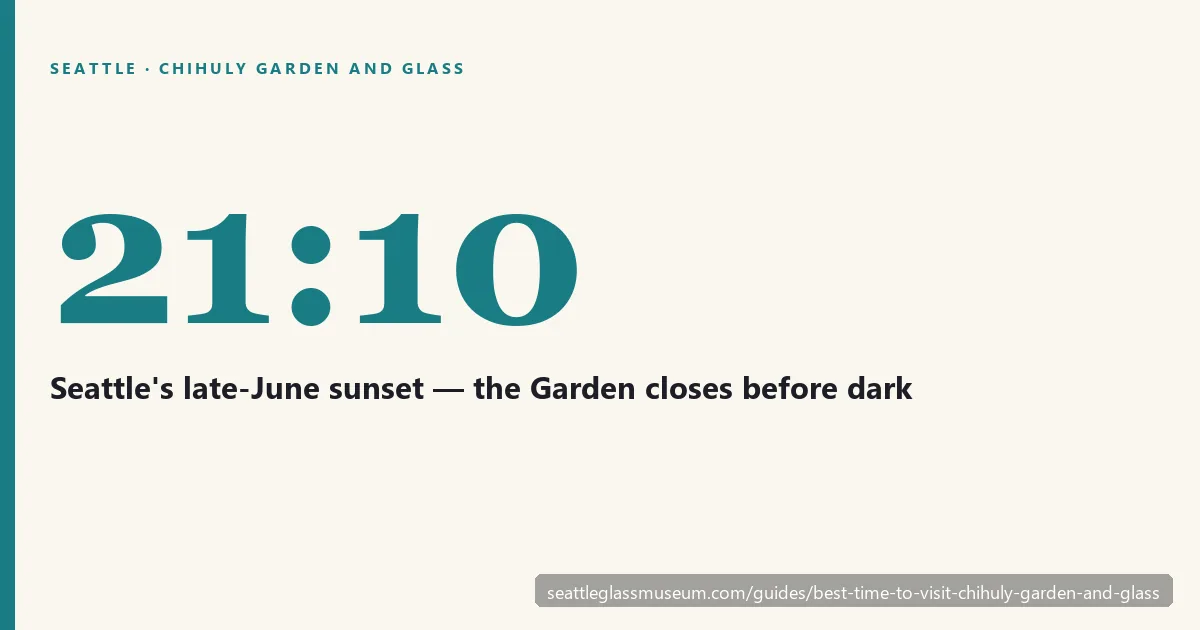
| Late June | ~21:10 | No — the site closes before dark |
| Late August | ~20:00 | Only on Friday or Saturday |
| Late September | ~19:00 | Yes, most days |
| Late October | ~18:00 | Yes, comfortably |
| December | ~16:20 | Yes — dark before closing every day |
That table is the counter-intuitive part. Midsummer is the worst time to see the Garden lit, because in June the sun is still up when the doors close. The autumn and winter months, which nobody picks for a Seattle trip, are the only ones where you reliably get both. If you are visiting in July or August and the lit Garden is what you came for, a Friday or Saturday evening is your only shot — check the posted hours before you commit, because they move.
Weekday or weekend, morning or evening
For crowds the pattern is the one you would guess. Weekday mornings are quietest, with Tuesday to Thursday noticeably calmer than Friday to Sunday. After 17:00 is the second quiet window, as the family traffic thins out.
The busiest combination is a summer Saturday afternoon, which is also when the Space Needle queue next door is at its worst — worth knowing if you hold the Space Needle combo ticket, because the timed half of that pairing is the one that will cost you the wait.
Since entry to Chihuly is untimed, you have complete freedom to move within your booked date. Use it.
Season by season
Spring (April–May). The best all-round window. The Garden’s living planting — rhododendrons in particular — is at its most active, which is exactly when glass-among-plants does what it was designed to do. Crowds are moderate and the weather is manageable.
Summer (June–August). Peak crowds, peak weather, and the one season where the after-dark visit is effectively unavailable. Excellent for the Garden in daylight, awkward for everything else. Go early.
Autumn (September–October). The other strong shoulder window. Sunset falls comfortably inside opening hours, the Garden still has colour, and visitor numbers drop off after Labor Day.
Winter (November–March). The Garden is at its sparest and Seattle is at its wettest — but the site is largely covered or lit, dark falls by mid-afternoon so the illuminated Garden is guaranteed, and it is the quietest the exhibition gets. If you are choosing a Seattle indoor attraction because the weather is bad, this is close to the ideal one: only the Garden is genuinely exposed, and it is a short loop.
Time your visit around the demonstrations
One scheduling constraint beats all of the above. The live glassblowing demonstrations and daily Gallery Talks are included with admission but run to a posted schedule, not on request. There is no booking and no repeat.
Visitors name the demonstration more often than any single artwork as the thing that made the visit. Check the board when you arrive and build the rest of your time around the next slot rather than discovering you missed it by ten minutes on your way out.
Frequently asked questions
Is Chihuly Garden and Glass better during the day or at night?
They are different rather than better or worse. Daylight suits the Garden and makes the Glasshouse translucent; after dark the outdoor glass is floodlit against black and the Glasshouse glows. Arriving in the late afternoon and staying through dusk gets you both on one ticket.
When is Chihuly Garden and Glass least crowded?
Weekday mornings, especially Tuesday to Thursday, and after 17:00 on any day. Summer Saturday afternoons are the busiest.
Can I see the Garden lit up in summer?
Rarely. Seattle’s sunset is around 21:10 in late June, after the exhibition closes on most days. In July and August a Friday or Saturday evening is the only realistic chance, and even then it is tight. Autumn and winter are the reliable seasons for a lit Garden.
What is the best month to visit?
April, May, September and October offer the best balance: an active Garden, moderate crowds, and a sunset that falls inside opening hours so both the daylight and after-dark versions are available.
How long before closing should I arrive?
At least two hours, and ideally more. The average visit runs 1–2 hours, and arriving with only an hour left means choosing between the galleries and the Garden rather than seeing both properly.
Is it worth visiting in the rain?
Yes — arguably more so. The galleries and the Glasshouse are entirely covered, and only the Garden loop is exposed, which is a short walk. It is one of the better wet-weather options in Seattle, and it is quieter when the weather is poor.
See the Glasshouse for Yourself
Eight galleries, the Garden and a 100-foot suspended sculpture, on a ticket that lets you arrive when you like. Rated 4.7/5 by 434 guests, with free cancellation up to 24 hours before.
Check Availability & Book